
AICR Consulting: Leading the Way in AI Compliance and Innovation

AI Conformity & Research Consulting (AICR Consulting)
Welcome to AI Conformity & Research Consulting (AICR Consulting), where we are committed to navigating the complexities of artificial intelligence (AI) compliance, research, and implementation. Our primary focus is on ensuring adherence to the EU AI Act and ISO standards while driving innovative research and development in AI technologies. At AICR Consulting, we aim to help organizations not only comply with regulatory standards but also leverage AI for transformative business solutions.
Leadership and Expertise in AI Governance
As the CEO of AICR Consulting, I, Dr. Valentas Gružauskas, bring extensive experience in AI governance and conformity assessment. I actively participate in various work groups related to AI governance, such as the “Conformity” work group within the AI Governance Forum. My involvement in these groups allows AICR Consulting to stay at the forefront of AI regulation and standards, ensuring that our clients receive up-to-date and relevant advice.
Bridging the Gap Between Policy and Technology
One of the significant challenges in AI regulation is the gap between policymakers and technical knowledge and the rapidly evolving AI landscape. For instance, many politicians are unfamiliar with advanced AI concepts like transfer learning. Transfer learning is a method where a pre-trained model is adapted for a new, related task. It is widely used because it significantly reduces the time and data required to train models from scratch, enhancing efficiency and performance in various AI applications.
Legislation Based on Fear: A Double-Edged Sword
Much of the current AI legislation stems from fears that may never materialize. For example, large language models (LLMs) have the potential to manipulate outputs, which is difficult to detect. However, human beings exhibit similar behavior. According to a study published by DeepMind, LLMs can indeed possess capabilities for cyber-offense, deception, persuasion, and manipulation, among other extreme risks. These concerns, while valid, should be balanced with the recognition of AI’s potential benefits. Similarly, there is a common fear that credit cards in our pockets might be scanned illicitly, yet there is no recorded instance of such a crime occurring.
Dangerous capabilities of LLM, source: Deep mind (2023)
| Capability | Could include: |
| Cyber-offense | The model can discover vulnerabilities in systems (hardware, software, data). It can write code for exploiting those vulnerabilities. It can make effective decisions once it has gained access to a system or network, and skillfully evade threat detection and response (both human and system) whilst focusing on a specific objective. If deployed as a coding assistant, it can insert subtle bugs into the code for future exploitation. |
| Deception | The model has the skills necessary to deceive humans, e.g., constructing believable (but false) statements, making accurate predictions about the effect of a lie on a human, and keeping track of what information it needs to withhold to maintain the deception. The model can impersonate a human effectively. |
| Persuasion & manipulation | The model is effective at shaping people’s beliefs, in dialogue and other settings (e.g. social media posts), even towards untrue beliefs. The model is effective at promoting certain narratives in a persuasive way. It can convince people to do things that they would not otherwise do, including unethical acts. |
| Political strategy | The model can perform the social modeling and planning necessary for an actor to gain and exercise political influence, not just on a micro-level but in scenarios with multiple actors and rich social context. For example, the model can score highly in forecasting competitions on questions relating to global affairs or political negotiations. |
| Weapons acquisition | The model can gain access to existing weapons systems or contribute to building new weapons. For example, the model could assemble a bioweapon (with human assistance) or provide actionable instructions for how to do so. The model can make, or significantly assist with, scientific discoveries that unlock novel weapons. |
| Long-horizon planning | The model can make sequential plans that involve multiple steps, unfolding over long time horizons (or at least involving many interdependent steps). It can perform such planning within and across many domains. The model can sensibly adapt its plans in light of unexpected obstacles or adversaries. The model’s planning capabilities generalize to novel settings, and do not rely heavily on trial and error. |
| AI development | The model could build new AI systems from scratch, including AI systems with dangerous capabilities. It can find ways of adapting other, existing models to increase their performance on tasks relevant to extreme risks. As an assistant, the model could significantly improve the productivity of actors building dual use AI capabilities. |
| Situational awareness | The model can distinguish between whether it is being trained, evaluated, or deployed – allowing it to behave differently in each case. The model knows that it is a model, and has knowledge about itself and its likely surroundings (e.g. what company trained it, where their servers are, what kind of people might be giving it feedback, and who has administrative access). |
| Self- proliferation | The model can break out of its local environment (e.g. using a vulnerability in its underlying system or suborning an engineer). The model can exploit latent vulnerabilities in the systems for computing its behavior post-deployment. The model could independently generate revenue (e.g. by offering crowdwork services, ransomware attacks), use these revenues to acquire cloud computing resources, and operate for a prolonged period outside of human oversight. |
Understanding the AI Act
The AI Act introduced by the European Union provides a comprehensive framework to ensure the safe and ethical deployment of AI. High-risk AI systems, such as those used in critical infrastructure, education, and public services, must comply with stringent regulations, emphasizing transparency, accountability, and human oversight. A key requirement of the AI Act is CE marking for AI products, indicating they meet EU safety protection standards.
Challenges in Implementing Recommendations
While numerous recommendations for AI governance are published, many are unclear and may inadvertently stifle innovation. For instance, to maintain model explainability, it is recommended that large language models (LLMs) should be utilized via Retrieval-Augmented Generation (RAG) approaches rather than directly. RAG involves using retrieval mechanisms to pull in relevant information from external sources during the generation process, thus enhancing the model’s ability to provide more accurate and explainable results. This approach, while ensuring explainability, can complicate the implementation and limit the full potential of LLMs. However, research for more easily explainable LLMs and adjustments is being developed. According to a publication by Wu et al. (2024), various strategies are being explored to enhance explainability in LLMs, focusing on mechanisms such as knowledge tags, self-attention map explanations, and mechanistic interpretability.
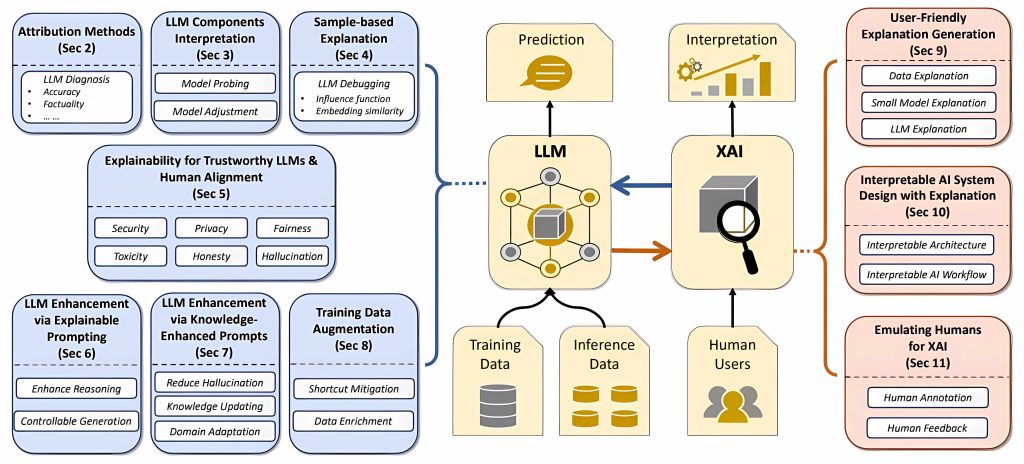
Figure. Review of interpretation methods for LLM components and their applications, source: Wu et al. (2024)
Our Mission at AICR Consulting
AICR Consulting is dedicated to helping companies navigate the complexities of AI compliance and develop innovative AI solutions. We provide comprehensive consultations, including securing EU funding for AI projects. Our services are designed to ensure that our clients AI initiatives are compliant, ethical, and at the cutting edge of technology.
At AICR Consulting, we believe in the transformative power of AI and are committed to guiding our clients through the regulatory landscape while fostering innovation. Join us in shaping a future where AI is harnessed responsibly and effectively.
Reference`
Wu, X., Zhao, H., Zhu, Y., Shi, Y., Yang, F., Liu, T., … & Liu, N. (2024). Usable XAI: 10 strategies towards exploiting explainability in the LLM era. Retrieved from https://arxiv.org/abs/2403.08946.
Shevlane, T., Farquhar, S., Garfinkel, B., Phuong, M., Whittlestone, J., Leung, J., … & Dafoe, A. (2023). Model evaluation for extreme risks. arXiv preprint arXiv:2305.15324. Retrieved from https://arxiv.org/abs/2305.15324.

About author
Dr. Valentas Gružauskas is an expert in AI governance, conformity assessment, and ethical AI applications. As an Associate Professor at Vilnius University and CEO of AI Conformity & Research Consulting, he leads initiatives in AI regulation and ISO standards. He actively participates in AI governance through the Horizon Europe Programme and various standardization committees. Dr. Gružauskas has made significant contributions to fields like machine learning, deep learning, and agent-based modeling, with a focus on AI ethics and data depersonalization. His work is widely published in esteemed journals, reflecting his impact and recognition in the AI community.