
Advancing Towards General AI: The Rise of Multi-Agent LLM Systems and Their Future

Emerging Trends in AI: The Rise of LLM Agents
In recent years, Large Language Models (LLMs) have revolutionized the AI landscape, rapidly advancing in their capabilities and applications. A key trend emerging in 2024 is the focus on LLM agents—sophisticated AI systems designed to perform tasks autonomously and collaboratively. This
was highlighted at the AI Engineer World’s Fair 2024, where Roman Huet showcased the capabilities of ChatGPT-4o, demonstrating the potential of these models in real-world scenarios.
Simultaneously, Andrew NG delved into the concept of Agent LLMs and Multi-Agent LLMs, emphasizing their role in transforming industries with smart, interactive agents that can work together seamlessly.
Recently, Joao Moura gave a compelling presentation titled “Using Agents to Build an Agent Company“; where he demonstrated how companies can automate and create entire departments—such as marketing and sales—using Agent LLMs. These developments underscore the pivotal shift towards integrating LLM agents in various sectors, promising a future where AI systems are not just tools, but intelligent collaborators.
What is an Agent LLM?
An Agent LLM, or Agent Large Language Model, is an advanced form of AI that leverages the capabilities of LLMs to perform specific tasks autonomously. At its core, an LLM generates text by predicting the most probable next word in a sequence, allowing it to produce coherent and contextually relevant responses to user prompts.
However, what makes Agent LLMs particularly powerful is their ability to interact with predefined functions, enabling them to perform more complex tasks beyond simple text generation. For example, imagine a function named get_sales that can query a database to find sales data for a specific store and region based on input variables like location and date. When a user prompts the LLM to find sales information for a particular store in a given region and time frame, the LLM can identify the appropriate function, generate the necessary input variables, and return the relevant data to the user. This process, known as tool use, allows the LLM to extend its capabilities by interfacing with external systems.
Moreover, the LLM can be integrated with an entire database of product information, enabling it to answer detailed queries about products, availability, and specifications. This integration turns the LLM into a versatile tool for businesses, capable of retrieving, analyzing, and presenting information efficiently, thereby enhancing decision-making processes and operational workflows.
What are Multi-Agent LLM Systems?
Previously, we defined an individual LLM agent, likened to a “junior data analyst”. This concept isn’t just theoretical; we can assign specific roles to Agent LLMs, such as planner, programmer, or marketing director. From a technical standpoint, this role definition is simply an addition to the prompt, often starting with “Imagine you are a senior software engineer…” or similar. By defining roles, we guide the LLM to become more proficient in performing specific tasks.
Taking this concept further, we can define a role like “planner” which could determine what roles are needed to solve a particular task. This planner could assess the requirements of a project, decide which departments or roles are necessary, and effectively organize the workflow.
When multiple roles are defined, we can create a system where several LLM agents interact with each other, simulating the operations of an actual department. For instance, consider a marketing department where one LLM agent acts as an analyst, gathering information from LinkedIn posts and generating trend statistics for a specific industry. Another agent, acting as a content writer, uses this data to draft a social media post. This draft is then reviewed by an LLM agent playing the role of the marketing director, who provides feedback for improvement before sending it back to the content writer. The content can also be cross-referenced with a database of products to tailor it specifically to the company. Once the marketing director approves the post, it can be automatically published.
In this context, the AutoAgents framework demonstrates an innovative approach by dynamically generating and coordinating multiple specialized agents that collaborate to tackle complex tasks. This system emphasizes the importance of role assignment and collaborative refinement among agents, allowing for more efficient problem-solving and adaptation to diverse scenarios (Chen et al., 2024).
This multi-agent LLM system could further extend to include tasks like audio calls, email writing, and more, especially with the advent of multi-modal LLMs that can process not only text but also vision and sound. These systems mimic real-world departmental interactions, allowing for more complex and collaborative workflows to be managed by AI, bringing us closer to fully autonomous business processes.
Innovative Applications of Multi-Agent LLM Systems in Simulated Environments
Simulating Autonomous Medical Care with Agent Hospital: Evolving LLM-Powered Medical Agents
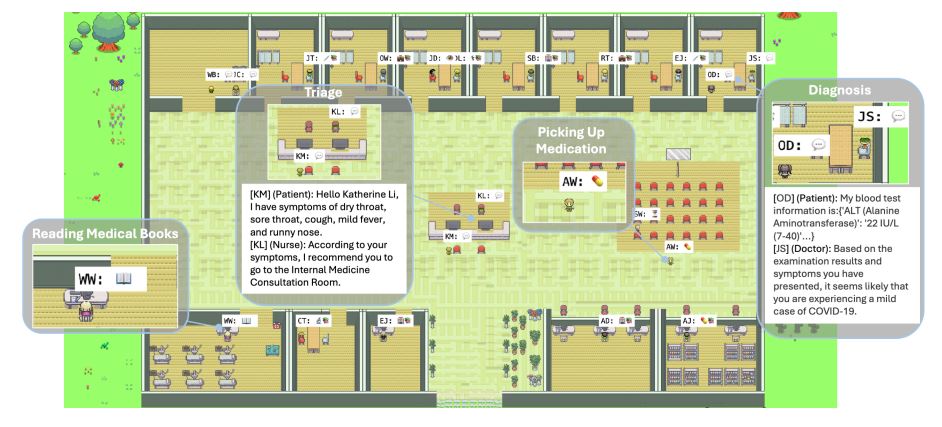
Figure 1. overview of Agent Hospital, Source: Li et al. (2024)
The “Agent Hospital” project aims to create a simulated hospital environment where Large Language Model (LLM)-powered agents, such as doctors and patients, autonomously interact to manage the full cycle of medical care. The primary goal is to train and evolve medical agents to improve their diagnostic and treatment capabilities over time. The simulation involves creating a detailed hospital environment where doctor agents perform tasks like diagnosis, treatment planning, and patient follow-up. These agents interact with patient agents, whose conditions and treatment outcomes are simulated based on predefined medical knowledge. A key innovation is the MedAgent-Zero strategy, which allows doctor agents to evolve by learning from their interactions without needing manually labeled data. The agents’ experiences are stored in a medical record library and an experience base, which are used to refine their decision-making processes in future scenarios. The practical value of this simulation lies in its ability to train AI-powered medical agents efficiently, with agents improving their performance on real-world medical benchmarks over time. This approach could significantly reduce the time and resources required to train AI systems in healthcare, making it a promising tool for advancing AI applications in medical diagnostics and treatment.
Automating Scientific Discovery with The AI Scientist: A Fully Autonomous Research System
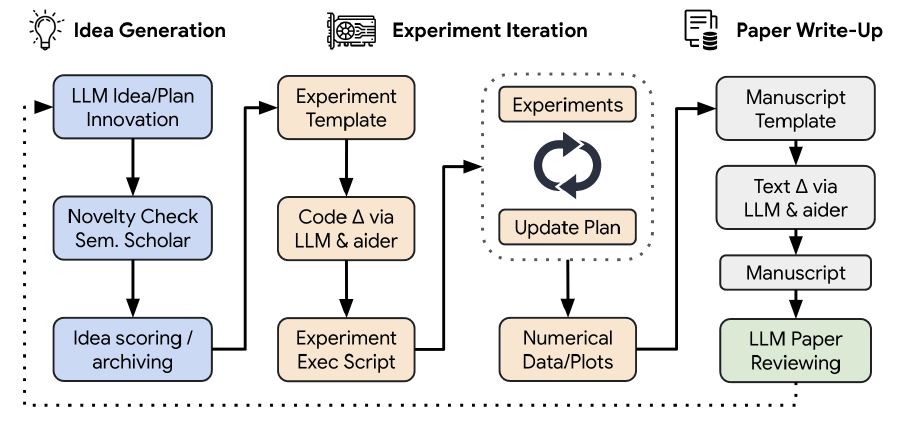
Figure 2. Conceptual illustration of The AI Scientist, Source Lu et al. (2024)
“The AI Scientist: Towards Fully Automated Open-Ended Scientific Discovery” aims to develop a fully automated system capable of conducting open-ended scientific research autonomously. Powered by Large Language Models (LLMs), this system is designed to generate novel research ideas, conduct experiments, write scientific papers, and even perform peer reviews without human intervention. The AI Scientist operates through three main phases: idea generation, experimental iteration, and paper write-up. It begins by brainstorming research directions, using evolutionary computation techniques to develop and refine ideas. The system then conducts experiments using an automated coding assistant, which plans and executes experiments, visualizes results, and logs findings. Finally, the AI Scientist writes up the results in the style of a scientific paper and uses an automated LLM-based reviewer to evaluate the quality of the generated research, aiming to emulate the iterative process of the scientific community. The practical value of the AI Scientist lies in its potential to democratize and accelerate scientific research. By reducing the time and cost associated with traditional research processes, such as producing papers for less than $15 each, it enables rapid iteration and exploration of ideas, potentially leading to faster scientific discoveries. This framework could be applied across various disciplines, significantly expanding the scope and efficiency of scientific inquiry.
OpenDevin: A Comprehensive Platform for Developing AI Software Agents with Multi-Agent Collaboration

Figure 3. OpenDevin user interface, source: Wang et al. (2024)
The paper titled “OpenDevin: An Open Platform for AI Software Developers as Generalist Agents” introduces a platform designed for developing AI agents that can interact with the world similarly to human developers, particularly through activities such as coding, command-line interactions, and web browsing. OpenDevin enables the creation of both generalist and specialist agents by providing a sandboxed environment for safe code execution and a variety of tools that enhance the agents’ capabilities. The platform supports multi-agent collaboration, where different agents can delegate tasks to one another, optimizing task-solving across multiple domains. Evaluation of the agents is conducted using a range of benchmarks that include tasks like software development, web interaction, and more, demonstrating the platform’s versatility and practical value in real-world applications.
Future Trends and Ethical Considerations in the Evolution of Multi-Agent LLM Systems
As these innovative applications of multi-agent LLM systems continue to evolve, they are paving the way towards the development of general artificial intelligence (AGI). This future vision encompasses creating LLMs that are not only as intelligent and capable as humans but potentially even surpass our abilities. The progress in autonomously managing complex tasks, such as those demonstrated in simulated environments, indicates that we are steadily moving closer to this reality. However, this journey towards AGI is accompanied by numerous ethical considerations that must be carefully addressed, including the implications of deploying such powerful systems in real-world scenarios. These ethical challenges will be crucial to explore and navigate as we move forward, and we will delve into these important issues in future discussions.
Sourse:
- Chen, G., Dong, S., Shu, Y., Zhang, G., Sesay, J., Karlsson, B., & Fu, J. (2024). AutoAgents: A framework for automatic agent generation. Peking University, Hong Kong University of Science and Technology, Beijing Academy of Artificial Intelligence, University of Waterloo. Retrieved from https://github.com/Link-AGI/AutoAgents
- Li, J., Wang, S., Zhang, M., Li, W., Lai, Y., Kang, X., Ma, W., & Liu, Y. (2024). Agent Hospital: A simulacrum of hospital with evolvable medical agents. Institute for AI Research (AIR), Tsinghua University, China. Retrieved from https://arxiv.org/abs/2405.02957
- Lu, C., Lu, C., Lange, R. T., Foerster, J., Clune, J., & Ha, D. (2024). The AI Scientist: Towards Fully Automated Open-Ended Scientific Discovery. Sakana AI, University of Oxford, University of British Columbia, Vector Institute, Canada CIFAR AI Chair. Retrieved from https://github.com/SakanaAI/AI-Scientist
- Hu, S., Lu, C., & Clune, J. (2024). Automated Design of Agentic Systems. arXiv preprint arXiv:2408.08435.
- Wang, X., Li, B., Song, Y., Xu, F. F., Tang, X., Zhuge, M., Pan, J., Song, Y., Li, B., Singh, J., Tran, H. H., Li, F., Ma, R., Zheng, M., Qian, B., Shao, Y., Muennighoff, N., Zhang, Y., Hui, B.,
Lin, J., Brennan, R., Peng, H., Ji, H., & Neubig, G. (2024). OpenDevin: An Open Platform for AI Software Developers as Generalist Agents. Arxiv. https://arxiv.org/abs/2407.16741

About author
Dr. Valentas Gružauskas is an expert in AI governance, conformity assessment, and ethical AI applications. As an Associate Professor at Vilnius University and CEO of AI Conformity & Research Consulting, he leads initiatives in AI regulation and ISO standards. He actively participates in AI governance through the Horizon Europe Programme and various standardization committees. Dr. Gružauskas has made significant contributions to fields like machine learning, deep learning, and agent-based modeling, with a focus on AI ethics and data depersonalization. His work is widely published in esteemed journals, reflecting his impact and recognition in the AI community.